
The Federal Reserve held its benchmark rate at 3.50% to 3.75% on July 29 in a 9-3 vote that showed real division inside the committee: Beth Hammack, Neel Kashkari and Lorie Logan all preferred a quarter-point increase.
That was the first time since September 2016 that three policymakers dissented in the same direction.
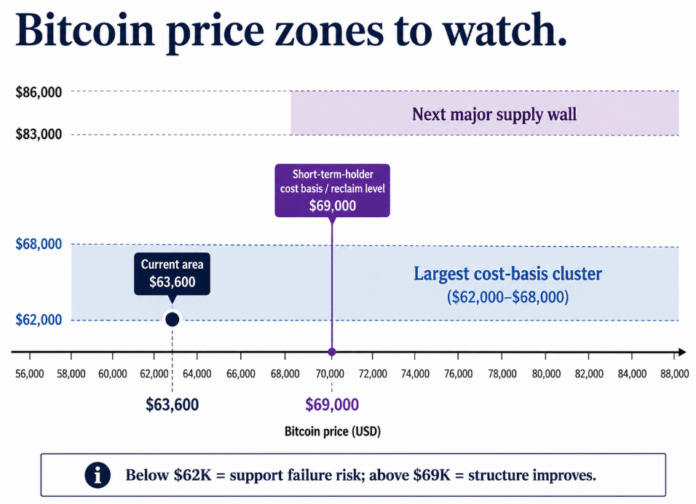
Bitcoin briefly traded above $64,000 once the decision landed, then slipped back toward $63,600 before reclaiming $64,000 overnight. That leaves it near the bottom of the price range on-chain analytics firm Glassnode considers most important for the current cycle.
Stephen Coltman, head of macro at 21Shares, called the hold a “sigh of relief.” He also described it as a gamble: a hot inflation print could force a difficult decision in September in the middle of the US midterm campaign.
The shelf Bitcoin is sitting on
Glassnode identifies $62,000 to $68,000 as the heaviest cost-basis cluster in Bitcoin’s supply profile. That band splits roughly evenly between long-term holders, who tend to provide support, and short-term holders, who are still underwater and more prone to selling into the next bounce.
Reclaiming $69,000, the short-term-holder cost basis, would flip that resistance into support and open a path toward the next major supply wall between $83,000 and $86,000.
Three-month Bitcoin futures basis has yielded less than the two-year Treasury since February, Glassnode found. That leaves institutional trading desks with little incentive to supply margin, depth and volume to crypto markets.
Spot volume has also fallen to its lowest level since 2019, and exchange activity is near a three-year low.
Farside Investors data show about $999 million came in from July 14 to 22, then about $526 million left across four straight outflow days through July 28. Cumulative net inflows still stand near $51.4 billion.
That reversal shows why July’s inflow streak fell short of confirming a new regime.
Can-Luca Köymen, an investment strategist at Sygnum Bank, said the Fed’s signal is that “the macro backdrop stays restrictive for a while longer.” His moderately constructive view depends on inflation staying manageable and is based on oil prices, ETF flows, and whether on-chain accumulation persists.
Iggy Ioppe, chief investment officer at Theo, sees “no clean catalyst” near term. That leaves the practical focus on generating yield, with directional exposure to Bitcoin on the sidelines.
Treasuries are out-yielding Bitcoin’s own carry trade, Glassnode’s basis data show, the clearest explanation for why the asset can hold up and still fail to break out.
The calendar that decides it
The next test lands quickly: the Fed’s preferred inflation gauge, the PCE report, arrives July 30 at 8:30 a.m. Eastern. July employment data follows on Aug. 7, and July CPI lands Aug. 12, shaping the debate before the Fed’s Sept. 15-16 meeting.
| Date | Event | Why it matters for Bitcoin |
|---|---|---|
| July 30 | PCE inflation | Tests whether the Fed’s preferred inflation gauge supports patience or renewed hawkishness |
| Aug. 7 | July employment report | Strong labor data could keep pressure on the Fed to stay restrictive |
| Aug. 12 | July CPI | Key test of whether oil-driven inflation is feeding into headline prices |
| Sept. 15-16 | FOMC meeting | Decides whether July’s divided hold becomes a September hike debate |
June’s CPI report gave the disinflation case some support: headline inflation fell 0.4% month over month, and core inflation held flat. Energy prices dropped 5.7% that month, the single largest driver of the decline.
Brent crude settled 7.91% higher at $90.74 on July 29 as Middle East airstrikes resumed, turning oil into the wild card working against that support. Tanker traffic through the Strait of Hormuz stayed low, and one forecaster expects Brent to swing between $80 and $100 in the near term.
In the bull case, inflation data stays manageable, oil retreats, and ETF inflows resume. Bitcoin clears $69,000, turning the short-term holder cost basis from resistance into support and opening the path toward the $83,000-$86,000 supply wall.
Ryan Lee, chief analyst at Bitget Research, said institutional demand “continued to absorb much of the initial volatility” as soon as the Fed decision landed. That only validates the bull case if the buying survives the PCE, jobs and CPI releases and helps push Bitcoin back above $69,000.
In the bear case, oil stays elevated, inflation surprises to the upside, and traders start pricing in a more aggressive September hike. Bitcoin loses $62,000, putting short-term holders inside the cost-basis shelf under greater strain and risking a deeper version of the current drawdown.
| Scenario | Macro condition | Bitcoin confirmation level | What it would mean |
|---|---|---|---|
| Bull case | Inflation cools, oil retreats, ETF inflows persist | Break above $69,000 | Short-term-holder cost basis flips into support; path opens toward $83,000-$86,000 |
| Base case | Inflation stays manageable but Fed remains restrictive | Holds $62,000-$68,000 | Bitcoin remains range-bound while Treasuries keep paying investors to wait |
| Bear case | Oil stays high, inflation surprises, September hike odds rise | Break below $62,000 | Short-term holders face more pressure; drawdown risk deepens |
| Liquidity shock | Macro surprise hits thin spot volume | Fast move through support or resistance | Low activity cuts both ways: quiet markets can move violently |
Andrei Grachev, managing partner at DWF Labs, noted that tighter policy leads to less liquidity and more expensive carry. He expects institutional positioning to turn defensive fast in that scenario, with risk assets absorbing the biggest hit.
Bitcoin’s next move depends on whether macro strain eases enough for a marginal buyer to return. Until then, the market keeps getting paid to wait: Treasuries out-yield Bitcoin’s own carry trade, and the $62,000-to-$68,000 shelf has held for weeks without resolving in either direction.