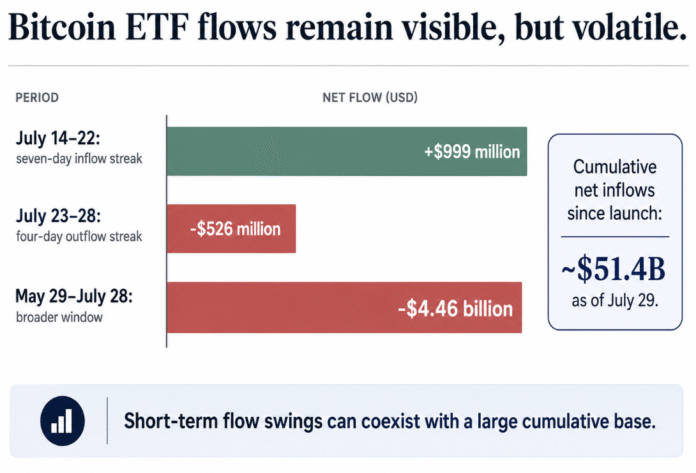

US spot Bitcoin ETFs took in roughly $999 million over seven straight days of inflows from July 14 to July 22, according to data from Farside Investors. Four straight outflow days followed, pulling about $526 million back out through July 28.
Across the broader window from May 29 to July 28, daily totals imply roughly $4.46 billion in net outflows. Cumulative net inflows since launch still stood near $51.4 billion as of July 29.
Swings like these are why traders default to ETF flows as their read on institutional conviction: heavy outflows read as lost interest, inflows read as renewed demand.
That framework now captures only one part of the market, since institutions can reach Bitcoin through spot ETFs, options-income products, Bitcoin-backed lending and structured credit.
Capital leaving one wrapper can just as easily move to another corner of the same market.
A wider menu of Bitcoin risk
BlackRock’s IBIT, still the benchmark spot product, had roughly $60.3 billion in cumulative net inflows as of July 28 and a 30-day median bid-ask spread of 0.03%.
BlackRock’s newer iShares Bitcoin Premium Income ETF (BITA) launched in June and had about $59.9 million in net assets by July 28. BITA trades part of its upside for income, writing covered calls on 25% to 35% of its portfolio through a laddered program for a stated 12.1% distribution rate.
Crypto-backed lending reached about $67 billion in the first quarter of 2026, up nearly 50% year over year, according to Galaxy Research. Ledn’s $188 million Bitcoin-backed asset-backed security became the first major investment-grade-rated digital asset lending securitization from a global credit-rating agency, Galaxy said.
S&P stressed that the rating covers the structure and senior notes.
Adam Reeds, the chief executive of Bitcoin lender Ledn, argued that measuring institutional demand now requires looking past any single wrapper.
A credit investor can hold Bitcoin as collateral and stay neutral on its near-term price, which is a distinction that reshapes what “institutional adoption” describes.
| Bitcoin-linked product | What investors are buying | Main return source | Main hidden risk |
|---|---|---|---|
| Spot Bitcoin ETF | Liquid Bitcoin price exposure | BTC appreciation | Daily flow sensitivity and sentiment-driven selling |
| Options-income ETF | Bitcoin exposure plus option premium | Yield from covered calls | Capped upside, volatility risk, assignment/overwrite risk |
| Bitcoin-backed lending | Dollar returns secured by BTC collateral | Loan interest and collateral protection | LTV drift, margin calls, forced liquidation |
| Structured BTC credit / ABS | Fixed-income exposure to BTC-backed loans | Coupon, spread compression, principal repayment | Servicing risk, custody risk, secondary-market bid risk |
| Direct Bitcoin custody | Ownership of the asset itself | BTC appreciation and long-term holding | Custody, operational risk, no yield unless rehypothecated |
The limits of a longer maturity
Reeds used Ledn’s bond product as an example, noting that investors can exit before maturity, and their return still depends on secondary-market pricing.
Holding to maturity preserves the contractual principal payment, while an investor who sells early takes on spread movements and, potentially, a weaker bid than expected.
In Reeds’ view, ETF buyers respond more to price momentum and the news cycle than investors who hold Bitcoin directly, whom he sees as carrying longer-term conviction.
He drew that conclusion from what he sees in the market each day, and it reflects buyer motivation. Which group proves more durable in a downturn is a separate, unresolved question.
The same maturity structure that can make credit capital look sticky can also make it fragile at specific price levels.
If a Bitcoin-backed loan starts at 50% loan-to-value and liquidates at an 80% threshold, the collateral can absorb roughly a 37.5% decline in Bitcoin’s price before triggering liquidation. Using a Bitcoin price near $63,889, the math implies a liquidation zone near $39,900.
A loan that starts at a 40% initial loan-to-value ratio would require a 50% decline to reach the same 80% threshold, which is around $31,900.
Reeds has a direct answer for this fragility:
“As you add leverage to the market, it would create more forced selling because of different positions where there are liquidation thresholds.”
Global fixed-income markets totaled about $145.1 trillion in outstanding value in 2024, compared with roughly $126.7 trillion in global equity market value, according to SIFMA’s 2025 fact book. That disconnect is the scale argument for why credit carries weight beyond crypto’s own market.
| Starting loan-to-value | Liquidation threshold | BTC decline needed to trigger liquidation | Implied BTC liquidation zone* |
|---|---|---|---|
| 50% LTV | 80% LTV | 37.5% decline | ~$39,900 |
| 40% LTV | 80% LTV | 50.0% decline | ~$31,900 |
Reeds made a similar point about the pool of potential lenders:
“The debt markets are bigger than the equity markets. There’s a lot more capital that wants to lend than would want risk capital willing to take a bet on the price of Bitcoin.”
How much of that theoretical pool has entered Bitcoin credit is a separate question that independent data has yet to settle.
The Fed held its target rate range at 3.50% to 3.75% on July 29, with inflation still elevated and Treasury yields higher. That combination can squeeze Bitcoin twice: by dulling appetite for speculative duration, and by widening spreads on Bitcoin-linked debt.
VanEck’s June snapshot reported about $5 billion in US spot ETF outflows across 19 of 22 sessions, accompanied by weaker price momentum and an elevated put skew.
In the bull case, institutions treat Bitcoin collateral as its own credit asset class. More asset-backed security issuance, lower lending rates, tighter secondary-market spreads and climbing assets in options-income products would all point that direction.
Bitcoin demand would deepen beyond directional buyers, and volatility could ease in ordinary market conditions.
In the bear case, ETF outflows, defensive options positioning and widening credit spreads move together. Renewed multi-billion-dollar ETF outflows, elevated put skew, wider asset-backed-security yields and borrower collateral calls would all show up at once.
ETF outflows would turn more dangerous under that scenario, since they would be arriving alongside credit strain that has stayed largely invisible until tested.
ETF flows still carry real information, tracking the movement of liquid, spot-wrapper capital in a way private credit and options books rarely match.
The full institutional Bitcoin risk stack now forming around options income, collateralized lending and structured debt sits mostly outside that picture. A dashboard that tracks only daily ETF creations and redemptions would still miss loan-to-value ratios, liquidation thresholds, secondary-market spreads and custody concentration.
The next major Bitcoin drawdown might answer whether credit and yield products brought durable capital into the market.